
By Daniela Vancic
Daniela Vancic is Policy & Advocacy Lead at Democracy International and a colleague of ours at the European Civic Forum. She was in Belgrade as an election observer for Serbia’s parliamentary elections on 25 October. This is a shorter version of an article she first wrote for Democracy 27.
This was not my first time observing elections in Serbia. I was also there for the parliamentary elections in December 2023. Afterwards there were serious allegations of irregularities, voter pressure and misuse of public resources. The ruling party’s built-in advantages had created a deeply unequal playing field.
When I went back to Belgrade as an observer this October, I found a very different country. Everything changed in November 2024, when the canopy of the Novi Sad railway station collapsed and killed 16 people.
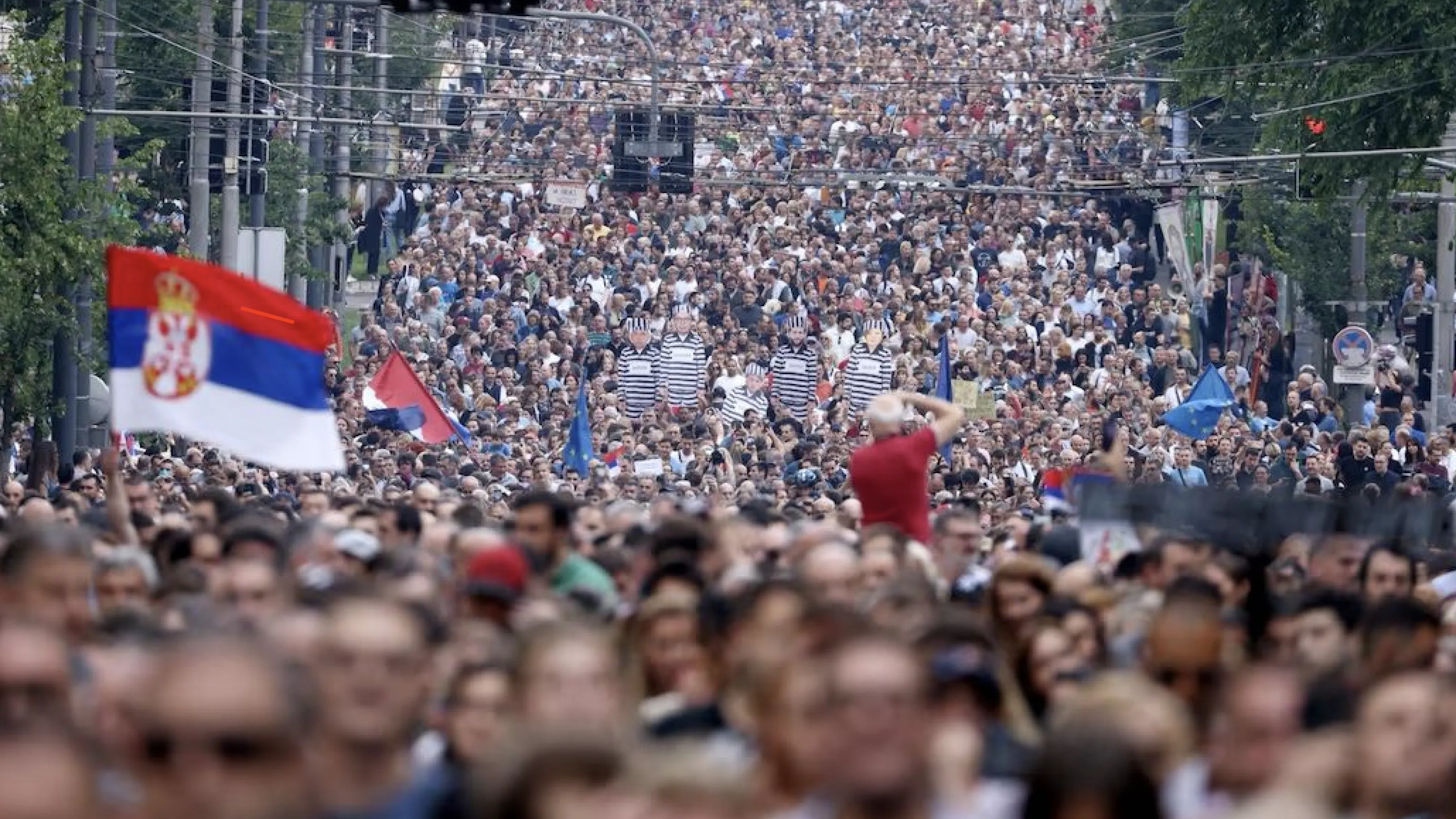
For many Serbians it became a symbol of what had gone wrong: corruption, negligence, and a system where nobody seemed to answer for anything. What followed was the largest wave of protest Serbia has seen since the fall of Milošević.
What happens when students refuse to back down?
What I find most remarkable is that the students didn’t stop at protest. They organised, and they grew far beyond their campuses into a nationwide force demanding accountability and change. T
Three things stood out to me:
- 1) They found issues that unite. Shared demands for accountability, justice and change brought very different parts of society together.
- 2) They practised democracy instead of just demanding it. At their universities they held open plenums where everyone could speak and decisions were made together. That model spread to towns and neighbourhoods through citizens’ assemblies, the zborovi, and gave people who had never been politically active a way to take part.
- 3) They went beyond the big cities. Students marched to smaller towns and rural communities, reached far more people, and brought citizens from every part of Serbia into the movement.
From the streets to the ballot box
Then the political ground shifted.
In September, Aleksandar Vučić resigned as president seven months before the end of his term. That cleared the way for him to run for prime minister in snap parliamentary elections.
For me, the real turning point was the movement’s decision to meet that challenge at the ballot box.
The Students’ List brought together people from across the political spectrum around one shared agenda: tackling corruption, restoring the rule of law, and holding power to account.
None of its candidates were students. The list was made up of professionals and experts, and I see that as proof that this had become an effort shared across generations.
On 25 October it paid off.
According to preliminary results, the Students’ List won nearly 53% of the vote and 140 of the 250 seats in parliament. Turnout was around 69%, the highest in more than three decades.
We shouldn’t forget the conditions this happened under.
Just as in 2023, state resources and the ruling party’s campaign were blurred together, and opposition activists faced intimidation.
The movement had none of those advantages. It had volunteers, community networks, social media, and countless conversations with voters.
The election watchdog CRTA concluded that it was, above all, strong voter mobilisation that made a change of government possible on such an uneven playing field.
What Europe can learn
Democracy is not only about elections or who holds power. It is also about how people organise, take part in public life and hold their leaders to account.
My message to fellow civil society organisations across Europe is simple: never underestimate organised citizens.
Frustration with politics doesn’t have to end in resignation, or in anti-system populism. It can be where democratic renewal begins. That happens when anger becomes organisation, peaceful collective action, and a credible political alternative.
When citizens come together across social and geographical divides, they can challenge the status quo and be heard. Serbia has shown us that this is possible.
Now it’s up to the rest of us to learn from it.
Hear it from the people who voted
Between observation duties in Belgrade, I spoke with Wojciech Oleksiak from The Europeans podcast, who was reporting from the city.
I really like this episode because it brings together different Serbian voices, each with their own concerns and hopes for what comes next. It also looks at what Serbia’s extraordinary grassroots student movement can teach protest movements elsewhere in the world.
If you want to hear the stories behind the results from the people who lived them, and relive the excitement of election night, give it a listen.
Listen to The Europeans episode
→ Read my full article on Democracy 27 →

Ten Wishes: put citizens at the heart of the UK-EU reset